 Deep Breath
Download
The scienceof breathing.
Explore the biology, physiology and real-world research behind breathing, from cells to the brain to whole-body performance.
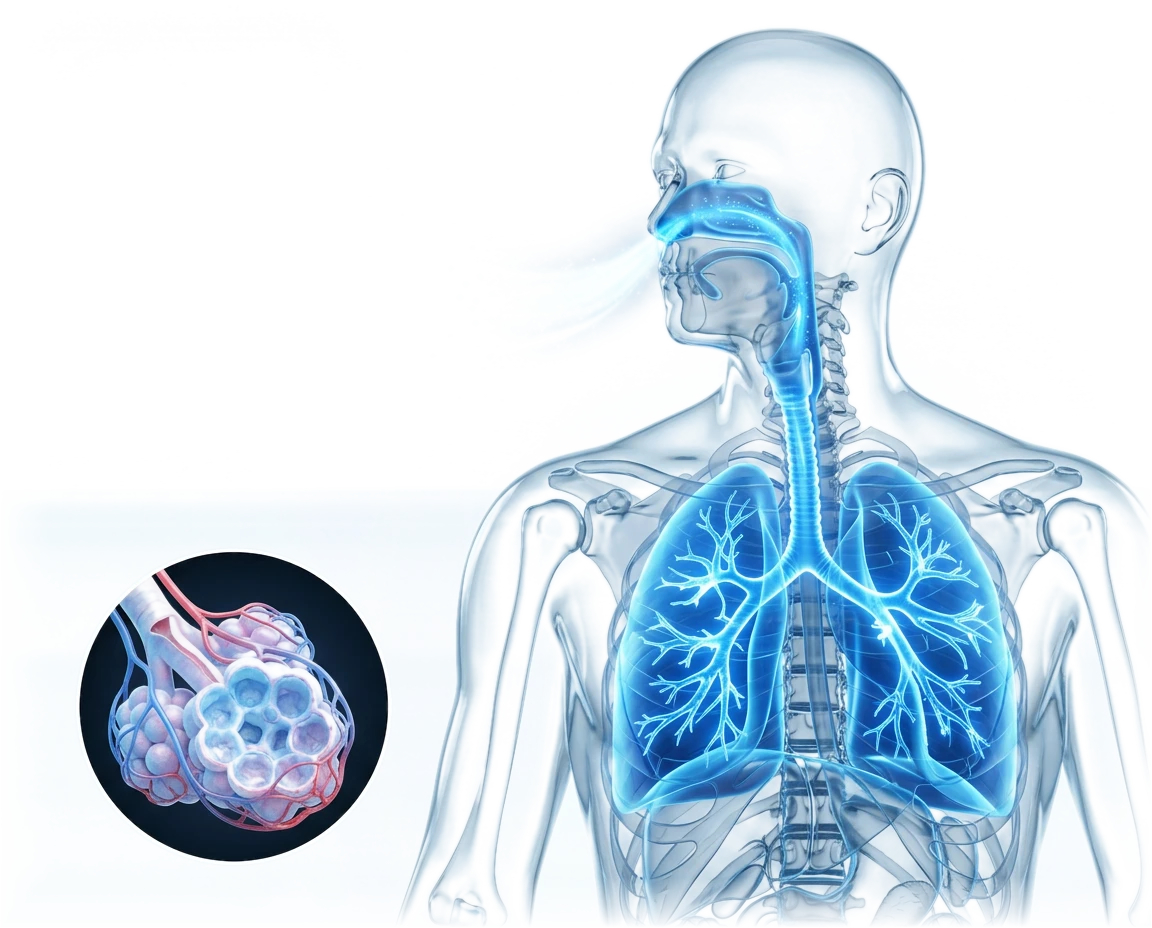
Breathing connectseverything.
From air to cells, breathing links the respiratory, cardiovascular, nervous and metabolic systems. Explore how it all works together.
 LungsAir intake and gas exchange
 CirculationOxygen transport and delivery
 CellsMitochondria and energy production
 BrainNervous system and regulation
A wider perspectiveon breathing.
Explore how low and high oxygen states influence physiology and performance, and how both are used in research, health and real-world contexts.

Hypoxic and hyperoxic axis
How different oxygen states affect the body and brain.

Mitochondrial biology
Cellular energy, ageing and adaptation.

Extreme environments
What divers, alpinists and cosmonauts teach us about breathing.

Systems integration
How breathing influences multiple systems, from cells to behaviour.

From the breathto the cell.
An illustrative look at the journey of oxygen, from inhalation to cellular energy production, and how breathing influences whole-body function.
Explore the research.
A curated library of key research, reviews and resources on breathing, physiology and human performance.
- Research articlesPeer-reviewed studies on intermittent hypoxia
- Methods and measurementsHBOT, IHHT and how they are studied
- Books and chaptersDeep Breath and its four appendices
- Related fieldsSpace medicine and mitochondria medicine
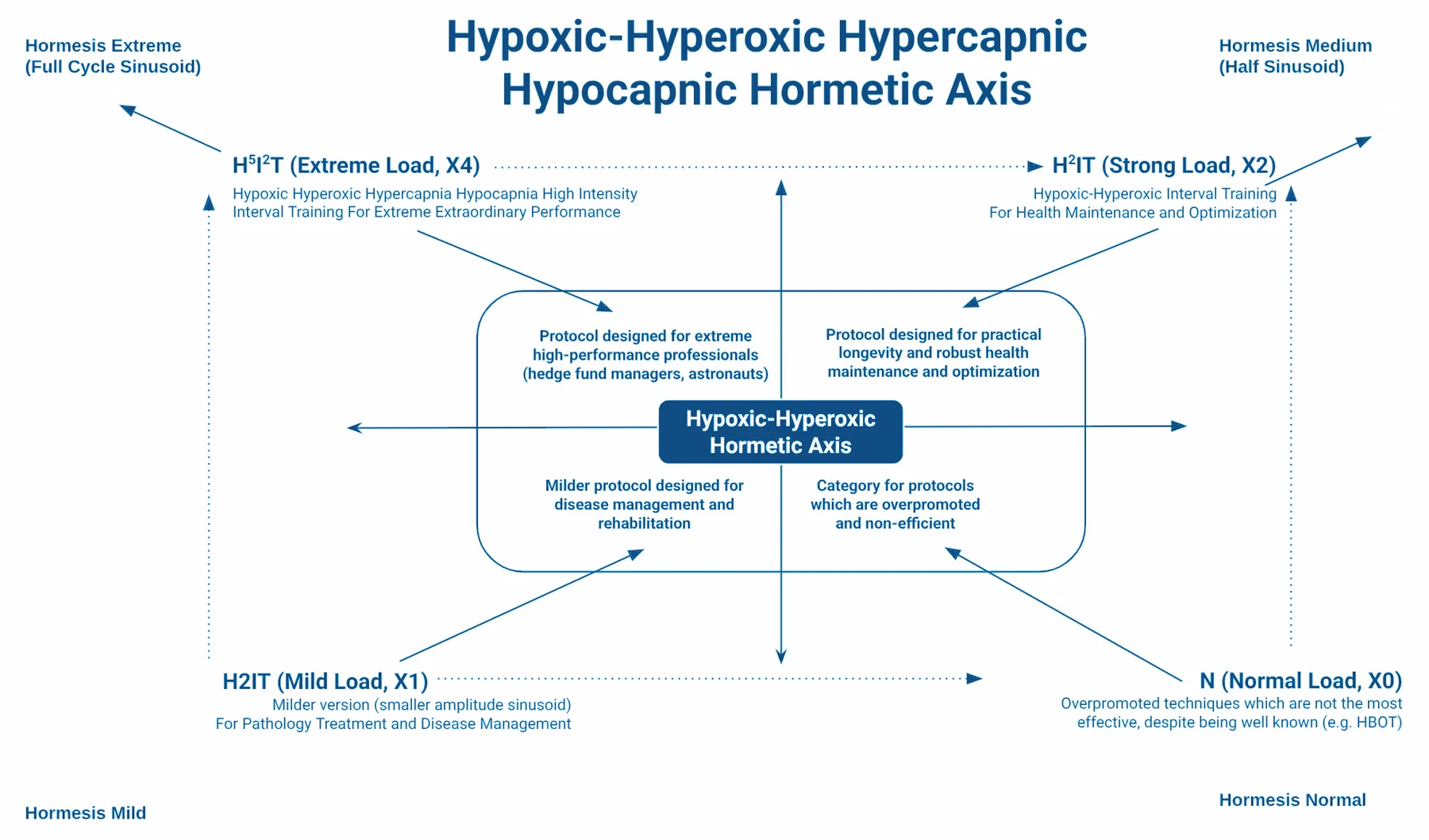
- Protocol overviewsFour load levels on the hormetic axis
- External resourcesOrganisations and further reading
Two opposite stimuli, one axis
Two complementary approaches sit at the centre of practical longevity research. Hyperoxic interventions, such as increased oxygen exposure under controlled conditions, aim to enhance tissue recovery, support mitochondrial function and stimulate regenerative processes. Hypoxic conditioning challenges the body with brief periods of reduced oxygen, activating adaptive stress-response pathways linked to metabolic flexibility, vascular efficiency and cellular survival.
Together, these opposing yet synergistic strategies form an oxygen-based axis for longevity, combining repair acceleration with resilience training.
Hyperbaric oxygen therapy
Hyperbaric Oxygen Therapy (HBOT) involves breathing 100% oxygen in a hyperbaric chamber, where the raised air pressure helps the lungs collect more oxygen. Dr. Shai Efrati, cofounder of Aviv Clinics, has developed oxygen therapy programmes since 2017.
A clinical study in late 2020 reported telomere elongation in circulating immune cells and fewer immunosenescent cells. Many ageing experts said the media coverage overhyped it: the T cells examined have highly dynamic telomeres that can change with regular exercise. In an April 2021 webinar hosted by Aging Analytics Agency, Dmitry Kaminskiy and Dr. Arkadi Prokopov discussed how a broader set of longevity biomarkers could have produced a clearer study.
IHHT and the MITOPRO protocol
Individualised normobaric Intermittent Hypoxic-Hyperoxic Training (IHHT) is based on the Mitochondria Optimization Protocol (MITOPRO), a therapeutic and regenerative method developed by Dr. Arkadi Prokopov. Unlike mitochondrial uncoupling, genetic modification or mitochondrial transfusion, it is based on the well-studied principle of regeneration activation.
Within its category, the IHHT protocol is designed to work more safely and effectively than other interventions such as hyperbaric chambers. Read the full background in mitochondria medicine, and one founder's experience in a personal account.
Decades of use in humans
The broad domain of intermittent hypoxic and hyperoxic stress has been used in humans for many decades, with a large body of evidence on its safety and efficacy. Studies have examined its safety and therapeutic value in humans for conditions including cognitive impairment and neurodegenerative disease, prediabetes, heart disease and cardiorespiratory conditions, coronary artery disease and impaired mobility.
Earlier research focused on athletic performance and high-altitude training, in young and older individuals, and on preparing cosmonauts for space flight.
These links point to the studies cited on the original website. Their findings apply to the conditions and protocols studied, and are not claims about results from the Deep Breath app.
Applications for demanding cognitive work
H5I2T (Hypoxic, Hyperoxic, Hypercapnia, Hypocapnia High-Intensity Interval Training) is presented as a promising protocol for neuro-performance in professionals with extraordinary cognitive demands, including financiers, hedge-fund managers and decision makers.
The original material describes three aims: building mental resilience against procrastination and low motivation through controlled stress exposure, increasing neuronal mitochondrial mass through fluctuating oxygen levels, and specialised breathing and stress modulation techniques for decision makers.
Two frontiers


References 16
- Hyperbaric Oxygen Therapy: Get the FactsU.S. Food and Drug Administration
- HBOT clinical study, 2020Aging (Albany NY)
- Practical Longevity webinar, April 2021Aging Analytics Agency
- The Hallmarks of AgingCell, via PubMed Central
- Safety and therapeutic value of intermittent hypoxia in humansJournal of Applied Physiology
- Cognitive impairment and neurodegenerative diseasePubMed Central
- PrediabetesHigh Altitude Medicine and Biology
- Heart disease and cardiorespiratory conditionsPubMed
- Coronary artery diseasePubMed
- Impaired mobility in older adultsBMC Geriatrics
- Effects of hyperoxic training on human performanceGerman Journal of Sports Medicine
- Intermittent hypoxia in older individualsPubMed
- Intermittent hypoxia in space medicinePubMed
- Mitochondria in Longevity and Space MedicineAging Analytics Agency
- Biomarkers of Human LongevityDmitry Kaminskiy, 2021
- Hypoxic Training IndexWikipedia