 Deep Breath
Download

Space medicineand the HTI.
How controlled hypoxia was measured and dosed where the body is pushed furthest, and what the Hypoxic Training Index tells you.
The Hypoxic Training Index
The Hypoxic Training Index (HTI) measures the hypoxic stress a person actually receives during an intermittent hypoxic training session. Recording only the oxygen in the inhaled air says little, because two people breathing the same air respond differently. HTI measures the body's response instead, through blood oxygen saturation (SpO₂) read by a pulse oximeter.
Tissue hypoxia only begins when SpO₂ falls to about 90% or below, so readings above 89% do not count towards the index. Readings below 75% count as 75%, which caps the dose. HTI adds up how far below 90% saturation sits, second by second, across the session:
Because it measures the dose rather than the setting, HTI lets a programme be adjusted for each person and lets studies show that every participant received a comparable exposure. Target saturations during a session sit between 75% and 89%.
- 170 to 250Relaxed daily sessions, as described by Dmitry Kaminskiy
- 300 to 500Intensive sessions, a standard level for alpinists, high-performance athletes and marathon runners
- 819His personal maximum, in a 70 minute supervised session. Read the account
Why hypoxia must be controlled
Brief, measured low oxygen is a hormetic stimulus: a small, controlled stress that prompts the body to adapt, the same principle behind exercise and cold exposure. The benefit depends on the dose. Too little does nothing, and too much or too long stops being training and becomes harm.
That is why the method is built around measurement. In a biofeedback-controlled session the equipment reads SpO₂ continuously and adjusts the oxygen in the inhaled air to hold the target saturation, then returns to normal or oxygen-rich air for recovery. Cosmonaut preparation used the same logic: a known, repeatable dose, followed by recovery.
Never lower your oxygen saturation on your own. Hypoxic protocols are taught in the app with their own guidance, and intensive levels are carried out with specialised, supervised equipment. Read the Safety Guides for Beginners first.
Preparing cosmonauts
Before formal clinical trials, intermittent hypoxic and hyperoxic breathing was a core, standard and systematically applied technique for training cosmonauts for space flight within USSR-era space medicine.
Unusually, this domain gathered a large amount of evidence in humans before it showed positive results in model organisms.
Where the Deep Breath protocol comes from

In Dmitry Kaminskiy's 2021 book Biomarkers of Human Longevity, he describes the IHHT protocol he uses as developed by Dr. Arkadi Prokopov, an integrative medicine physician and gerontologist with over 30 years of experience in the effects of hypoxia and hyperoxia on human longevity. Dr. Prokopov developed his specialised IHHT protocol through his work in a government-led space medicine programme.
The equipment comes from Dr. Prokopov's company, Athletic HighTech S.L.
Extreme environments
Deep-sea divers
Improving diving performance
Alpinists
High-altitude training
Endurance athletes
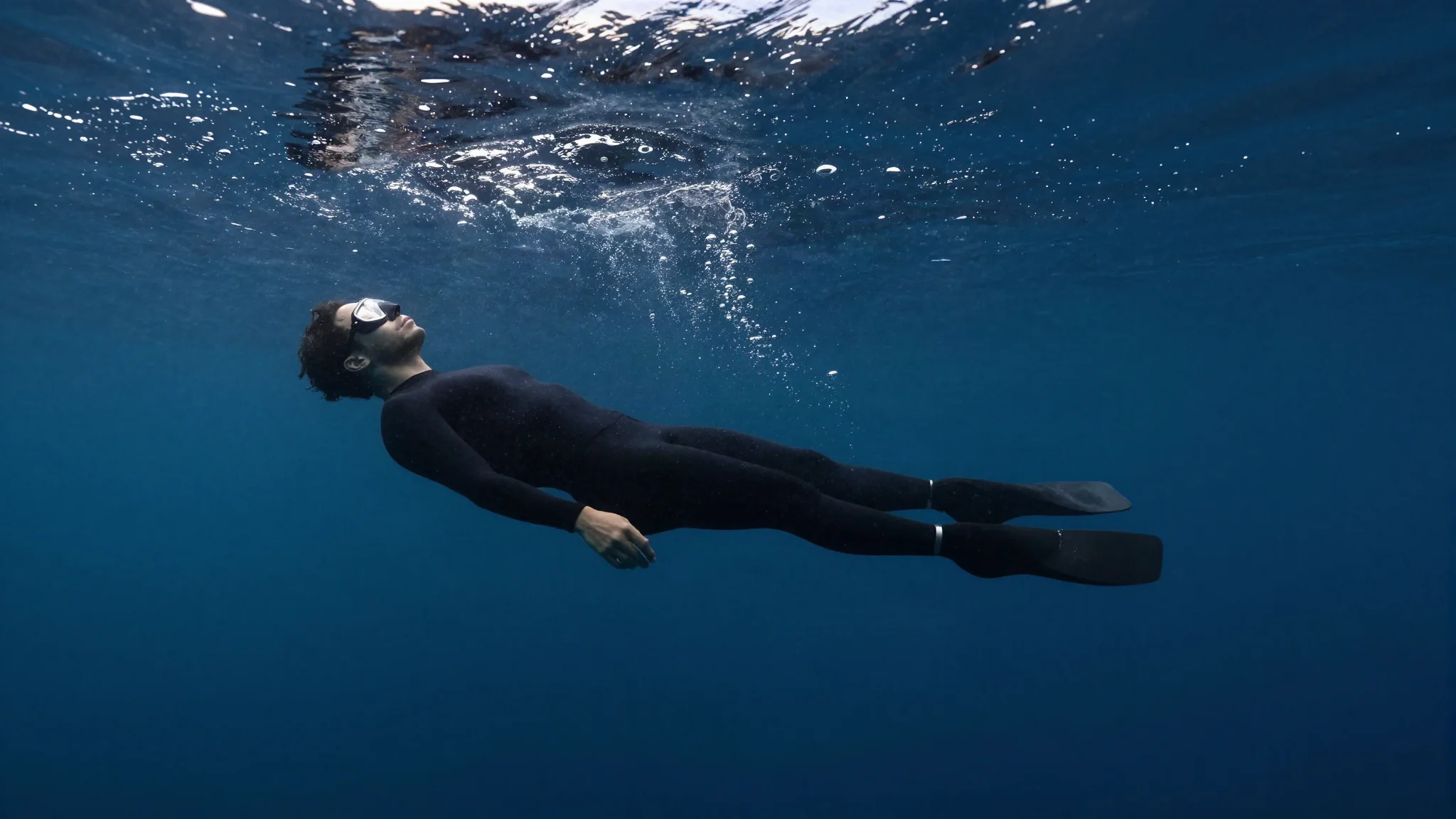
Olympic champions, marathon runnersThe same family of techniques has been used to improve the performance of deep-sea divers, as a preventive strategy against occupational hazards in extreme environments, such as the clean-up groups working in Chernobyl, and in high-altitude (alpine) training.
Today, intermittent breathing techniques enhanced by specialised equipment, including IHHT, HBOT and related protocols, are used by Olympic champions, long-distance runners, deep divers and alpinists, and by professionals in intensive occupations to support cognitive performance and endurance.
Divers, alpinists and athletes are shown as illustrative artwork. The Deep Breath app does not reproduce extreme-environment training.
Research today
Aging Analytics Agency published the analytical case study Mitochondria in Longevity and Space Medicine, and in June 2021 hosted the conference Practical Applications of Mitochondria Research for Human Longevity and Space Medicine, where Dmitry Kaminskiy spoke about intermittent breathing methods.
Continue with mitochondria medicine, the cellular side of the same story.
References 7
- Hypoxic Training IndexDefinition and calculation
- Intermittent hypoxia in USSR-era space medicinePubMed
- Mitochondria in Longevity and Space MedicineAging Analytics Agency
- Mitochondria research conference, June 2021Aging Analytics Agency
- The specialised IHHT protocolVideo
- Athletic HighTech S.L.Equipment
- Biomarkers of Human LongevityDmitry Kaminskiy, 2021